
Marketing — the under-used tool for social good.
Modern societies face complex social challenges. In developed nations: ageing populations and chronic disease. In developing regions: poverty, infectious disease and infrastructure gaps. Together: climate change and sustainable development. Marketing is one of the most under-used tools for addressing them.
What is social marketing?

“Social marketing seeks to develop and integrate marketing concepts with other approaches to influence behaviours that benefit individuals and communities for the greater social good.”
Consensus definition endorsed by iSMA, ESMA and AASM
Read the consensus definition (PDF) →A citizen-centred, integrated strategic approach
Social marketing uses insight into what citizens value to develop effective programmes that have public support. Many social programmes lack a deep understanding of citizens’ needs and systematic planning. Applying a social marketing approach brings five key benefits:
- Policies reflect citizens’ needs and wishes more accurately.
- Clear, measurable behavioural targets are set.
- Under-performing investments are identified.
- Resources are concentrated on interventions with the highest return.
- We learn more about what works — and what the public will accept.
Institutions that back the approach
Public health bodies across Europe recognise social marketing as a way to make limited resources go further.
United Kingdom — National Social Marketing Centre
A report by the UK National Consumer Council recognised the potential of social marketing and recommended establishing a centre to build national capacity.
European Centre for Disease Prevention and Control
The ECDC recognises social marketing as a helpful tool to enhance the effectiveness of efforts to protect and improve public health — particularly where resources are limited.
One principle, six concepts
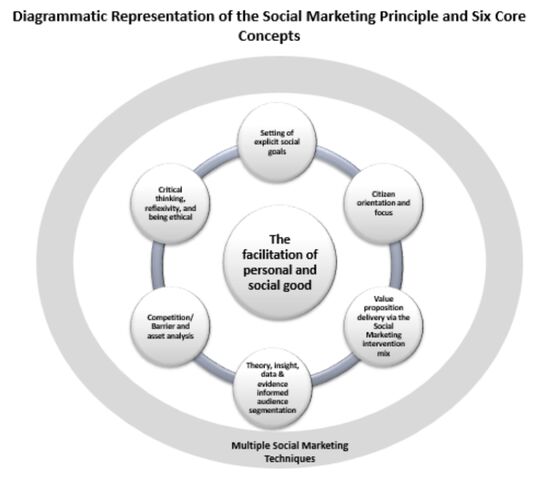
Understanding social marketing means distinguishing between its principle, its six core concepts and the techniques it uses.
Fundamental principle: creating individual and social benefit.
Core concepts:
- Citizen orientation and targeting
- A clearly defined social objective
- Delivering a value proposition through the intervention mix
- Audience segmentation based on theory and evidence
- Analysis of competition and resources
- Critical thinking, reflection and ethics
Techniques: systematic planning and evaluation tools.
Fifty years of evidence
Practitioners have used social marketing for more than 50 years to tackle disease prevention, family planning, environmental protection and crime reduction. In Greece, early examples go back to efforts to introduce new dietary habits by understanding cultural behaviour. Because of its documented record of success, social marketing is increasingly considered best practice in many countries.
Planning a programme that needs people to change behaviour?
Talk to us about training, research or a social marketing approach for your organisation.